Detecting Inground Pool Leaks in Princeton Estates
A private backyard swimming pool is a prized amenity in Princeton neighborhoods, from generous estates in the Western Section to properties bordering Littlebrook and Route 206. However, when water levels begin dropping faster than normal summer evaporation, pool owners face escalating water bills, chemical dilution, and potential soil erosion beneath expensive concrete pool decks.
When dealing with an inground pool leak Princeton homeowners cannot afford to tear up flagstone patios or excavate lawns without clear diagnostic proof. Our non-invasive pool leak detection isolates whether water is escaping from structural shell fittings, light conduits, or buried suction and return plumbing lines.
Losing Water in Your Princeton Swimming Pool?
Call (201) 510-1615 to talk directly with a leak detection specialist. We identify pool shell and underground line leaks without unnecessary deck demolition.
📞 Call (201) 510-1615The Bucket Test vs. Real Mechanical Leaks
Before initiating extensive diagnostics, it is crucial to verify that water loss exceeds natural seasonal evaporation:
How to Conduct the 24-Hour Bucket Test:
1. Fill a clean 5-gallon bucket with pool water and place it on the first step of your swimming pool so the water levels inside the bucket and in the pool are nearly equal.
2. Mark the water level inside the bucket and the pool water level on the outside of the bucket with electrical tape.
3. Turn off any automated pool fill valves and operate normal filtration for 24 hours.
4. After 24 hours, measure both drops. If the pool water level drops significantly more than the bucket water level, your pool has an active mechanical leak rather than simple solar evaporation.
Precision Diagnostic Methods for Pools
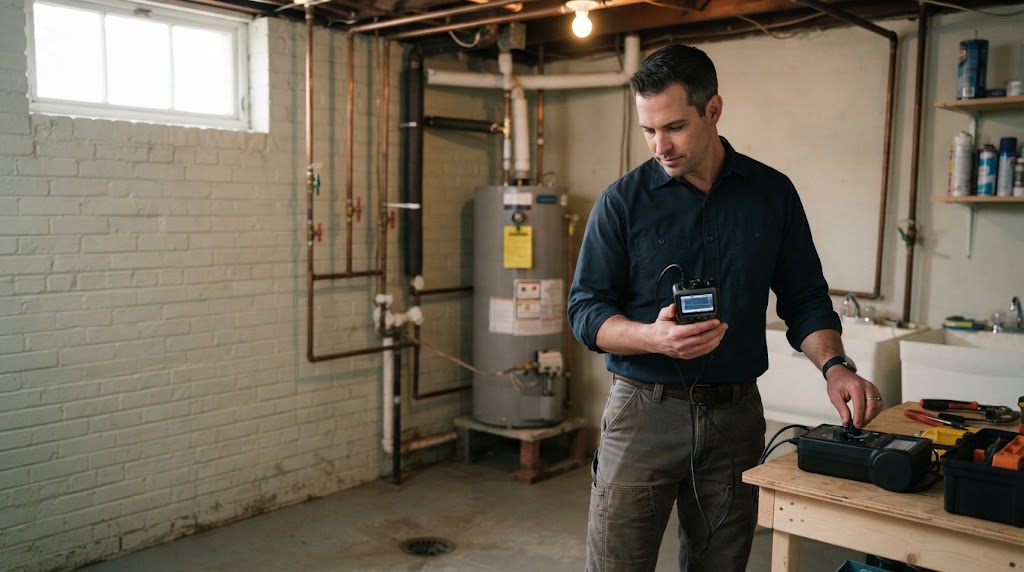
Once a physical leak is confirmed, our diagnostic specialists apply specialized equipment to find the exact failure point:
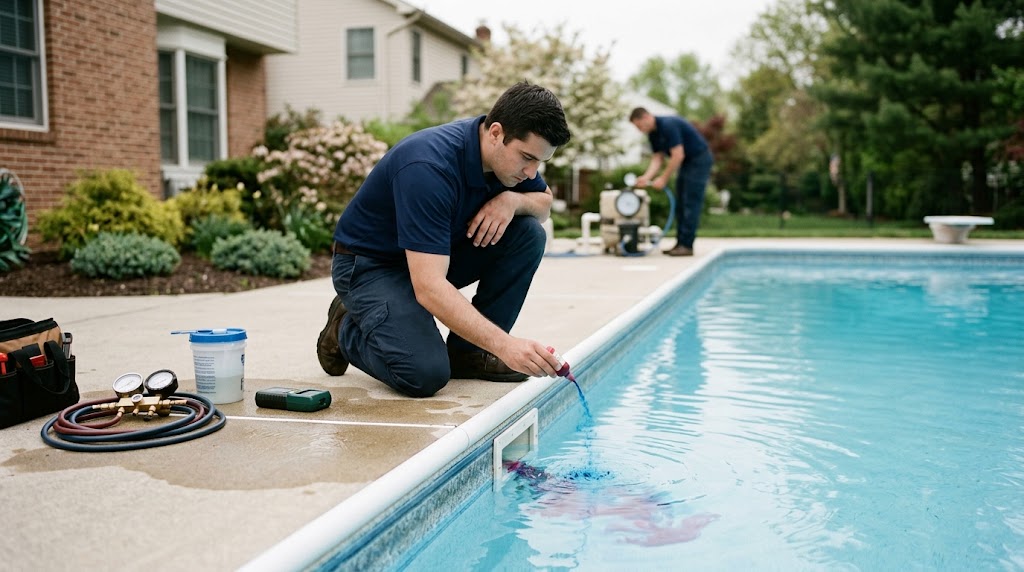
Fluorescein Dye Testing: In tranquil water, concentrated dye is released along skimmer throats, main drains, tile grout lines, and underwater light niches. Active structural cracks create suction that draws the dye inward.
Plumbing Pressure Testing: We seal and pressurize individual skimmer lines, main drain suction lines, and return return jet lines with test plugs and digital pressure gauges to detect pressure decay.
Acoustic Underwater Microphones: Hydrophones lowered into pool plumbing listen for the distinct acoustic vibration of water escaping buried PVC joints under deck slabs.
Common Pool Leak Locations & Winterizing Issues
In Central New Jersey, freezing winters present severe risks for pool plumbing infrastructure:
Freeze Damage After NJ Winters
If pool lines are improperly cleared of water during autumn winterizing, deep frost heaves cause residual water to freeze, expand, and split PVC joints beneath pool coping, which is discovered upon spring reopening.
Skimmer & Throat Separation
Differential ground settlement between the pool deck and the concrete pool shell frequently causes cracks where plastic skimmer assemblies meet the gunite shell wall.
Underwater Light Niches & Conduits
Pool light niches are sealed with electrical conduit that travels back to the equipment pad. If conduit seals crack behind the niche fixture, water siphons continuously into the surrounding earth.
Buried Plumbing Line Ruptures
A pool plumbing leak Princeton NJ often occurs in underground PVC lines due to heavy equipment traffic, tree root pressure, or shifting patio slabs.
Following diagnostic pinpointing, any necessary swimming pool leak repair Princeton plumbing work should be performed by qualified pool professionals and NJ licensed master plumbers for structural piping.
Our Step-by-Step Pool Diagnostic Process
Water Loss Rate Calculation
We assess daily water loss data with pumps running versus pumps off to determine whether the leak is on the pressure or suction side.
Structural Shell & Fitting Dye Testing
We systematically inspect skimmers, returns, lights, and tile lines using precision dye to rule out structural shell breaches.
Plumbing Circuit Isolation & Pressure Testing
We isolate suction and return lines with inflatable plugs and conduct hydrostatic pressure testing to identify the failing pipe line.
Acoustic Pinpointing & Repair Documentation
We trace the compromised line beneath pool decks or lawns to pinpoint the exact breach coordinate for minimal excavation.
Stop Constant Water Loss in Your Pool
Avoid expensive chemical waste and deck erosion. Call our Princeton pool leak specialists at (201) 510-1615 for precision diagnostic testing.
📞 Call (201) 510-1615Related Leak Locating Services in Princeton
Explore our full range of residential water leak locating services across Princeton:
- For buried main water lines supplying the house, visit water line leak detection.
- If water is leaking under indoor concrete slabs, see our slab leak detection page.
- For concealed interior pipes behind walls or ceilings, review hidden water leak detection.
- Learn more about our local service areas across all Princeton service areas and the Nassau Street district.
Frequently Asked Questions About Pool Leaks
How do I perform a bucket test to check for pool leaks?
Place a 5-gallon bucket filled with water on your pool step, match the water level inside the bucket with the pool water level, and mark both with tape. Turn off pool auto-fill for 24 hours. If the pool water level drops significantly more than the bucket level, you have a physical leak rather than natural evaporation.
Can New Jersey winter freezes cause underground pool line leaks?
Yes. Sub-zero temperatures during New Jersey winters expand residual water trapped in skimmer throats, return lines, or underground PVC pipes if lines were improperly blown out during autumn winterizing, leading to cracked fittings discovered during spring openings.
How is dye testing used to find pool shell leaks?
With pool pumps turned off and the water completely still, our specialists dispense concentrated fluorescein dye near suspect skimmer throats, tile lines, return fittings, and underwater light niches. If a structural fissure exists, active water draw pulls the dye directly into the crack.
Speak with a Princeton Pool Leak Specialist
Restore your pool water balance and stop deck soil erosion. Call (201) 510-1615 now to schedule professional pool leak detection.
📞 Call (201) 510-1615